Short answer: an archetype is your race plus your class. Each one has its own skill tree and its own passive. Nine are live at Early Access (3 × 3); 48 are planned for 1.0. Mudtek has named three examples officially — Vanguard, Earthshaker and Elemental Ranger.
How the system is built
Mudtek’s November 2025 design post is the clearest official explanation of archetypes, and it frames them as the seed of your entire build.
Official Design post, 16 November 2025
“Your first major decisions are your race and your class. These two choices are the seed from which your character will grow. The combination of race and class defines your archetype, and every archetype gets its own unique skill tree — built as a blend of race, class, and that archetype's identity.”
“These archetype trees are where you'll find spells and passives that no other archetype can use. They are the anchor of your build: the core set of tools, synergies, and power spikes that you will build around.”
Source: Mudtek Steam announcement, 16 November 2025 · verified 16 September 2026
The word “unique” is doing real work here. An archetype tree is not a generic class tree with a racial modifier bolted on. Mudtek states that each tree contains spells and passives no other archetype can access, which means the combination is content, not a multiplier.
Consequence for build guides. Because each of the nine launch archetypes has a different tree, advice written for a Minotaur Brawler does not transfer to a Human Brawler. Treat any Dimraeth “best build” list that does not name the racial pairing as incomplete.
The three officially named archetypes
Mudtek has published three archetype names, and each one illustrates a different part of the system.
| Archetype | Official name | What the official text tells us |
|---|---|---|
| Minotaur Brawler | Vanguard | Gains bonus stamina when levelling Strength |
| Minotaur Mage | Earthshaker | Built around spreading fire and proccing passives on Burning enemies |
| Human Mage | Elemental Ranger | Converts existing fire on the field into high-impact single-target damage |
Note that two of the three examples are Mage archetypes. That is not a coincidence in the source text — Mudtek used the Mage pair to demonstrate that the same class produces radically different play patterns depending on race. A Minotaur Mage and a Human Mage share a class and share almost nothing else.
The archetype passive
The passive is the simplest part of the system and the most quietly influential.
Official Design post, 16 November 2025
“There is a third element tied to your race–class combination: the archetype passive. This is a simple passive that adds an extra benefit to one of your attributes. For example, the Minotaur Brawler (a Vanguard archetype) gains bonus stamina whenever they level Strength, whereas other archetypes do not. Effectively, each archetype has a ‘primary’ attribute that gives you the most value per point, pushing you toward certain builds while still leaving room to experiment.”
Source: Mudtek Steam announcement, 16 November 2025 · verified 16 September 2026
Read that alongside the attribute-scaling rule and a clear picture emerges. Each archetype has:
- A primary attribute that gives the most value per point, reinforced by the passive.
- Expensive off-stats, because the XP cost of an attribute is primarily set by your race–class combination.
- A total budget, since spending heavily on off-stats leaves fewer points at max level.
The design intent, stated by Mudtek, is that every combination has clear strengths and weaknesses rather than being a blank slate.
The nine launch archetypes
At Early Access there are three races and three classes. Mudtek has not published the archetype names for all nine, so the table below names only the three that are official and leaves the rest labelled by pairing.
| Race × Class | Archetype name | Status |
|---|---|---|
| Minotaur × Brawler | Vanguard | Officially named |
| Minotaur × Mage | Earthshaker | Officially named |
| Human × Mage | Elemental Ranger | Officially named |
| Minotaur × Shadow | Not published | Playable |
| Human × Brawler | Not published | Playable |
| Human × Shadow | Not published | Playable |
| Elf × Brawler | Not published | Playable |
| Elf × Mage | Not published | Playable |
| Elf × Shadow | Not published | Playable |
Not published Six unnamed archetypes
The six archetypes without a name above are playable but unnamed in official material. If you see a site listing all nine with invented names, those names did not come from Mudtek.
Checked against: Steam store page, 30 Mudtek announcements, dimraeth.com · 16 September 2026
Co-op synergy: the Burning engine
The most useful official insight into archetypes is a co-op example. It shows that archetype pairing is designed to matter at party level, not just for the individual.
Official Design post, 16 November 2025
“In co-op, the archetype trees and attribute scaling are where party identities come from. One player might build a Minotaur Mage (Earthshaker) around spreading fire and proccing passives whenever enemies are Burning, while another builds a Human Mage (Elemental Ranger) that turns any existing fire on the field into high-impact single-target nukes. The result is a party that doesn't just ‘have two mages,’ but a coordinated Burning engine.”
Source: Mudtek Steam announcement, 16 November 2025 · verified 16 September 2026
The official example is worth restating because it explains how the game expects you to think:
- One archetype applies a status. Earthshaker spreads fire and triggers its own passives when enemies burn.
- A second archetype consumes it. Elemental Ranger converts fire already on the field into single-target burst.
- The output exceeds the sum. Neither archetype alone produces the result; the interaction does.
That is the same chain-interaction logic Mudtek describes for spells generally — igniting enemies then following with an inferno, stacking bleed to trigger an execution finisher, or layering frost and freezing an enemy in place.
How spells fit an archetype
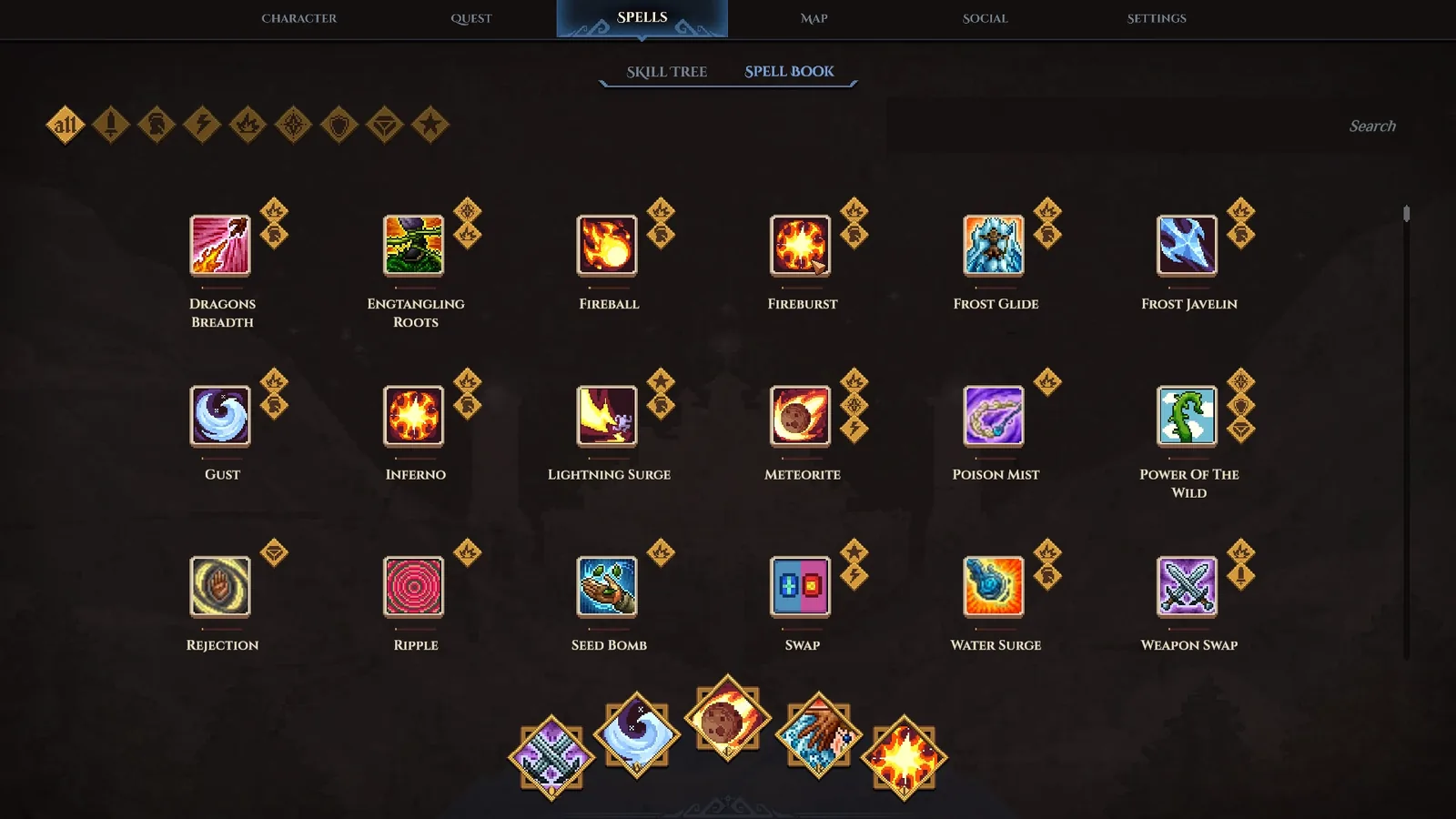
Your spell loadout is constrained by both archetype and attributes, and the store page explains the split.
Official Steam store page
“Equip five spells at a time and build tactical rotations and combinations around your loadout. Your race and class offer their own spells, while crafted spellbooks grant access to universal magic, provided you meet each spell's attribute requirements. More than 300 spells are available in total.”
Source: Steam store page · verified 16 September 2026
Three sources of spells, then: the archetype tree, the race, and crafted spellbooks. Only the first is archetype-exclusive. Spellbooks are the universal channel, and they are gated by attributes rather than by archetype — which is why an unusual attribute spread is described as a legitimate choice rather than a mistake.
Note Where spellbooks come from
Mudtek states that some recruited NPCs can craft spellbooks from materials gathered from monsters and bosses, and that “these spells are almost always reflections of the creature you took the materials from.” That ties the Sanctum recruitment system directly into archetype build options.
Source: Mudtek Steam announcement, 20 January 2026
Planning an archetype
Four questions, in the order the official systems suggest answering them.
1. Which default playstyle do you want? Race sets base kit: frontline, kiting or backline. Class cannot override it. Decide this first because it is the least changeable part of the build.
2. Which primary attribute does your archetype reward? Each archetype’s passive reinforces one attribute. Building against it is allowed but costs XP.
3. Which exclusive tools does the tree provide? The archetype tree holds spells and passives nothing else can use. Those tools define what the build can do that no other build can.
4. What does the party need? The Burning engine example shows that a build’s value can depend on what a teammate is running. In co-op, an archetype that applies a status is worth more next to one that consumes it.
Mudtek's full character-creation post closes by framing system mastery as the game's power fantasy: “understanding the system is itself a power fantasy.” That is an unusually direct statement of intent, and it explains why the studio publishes design posts in this much detail.