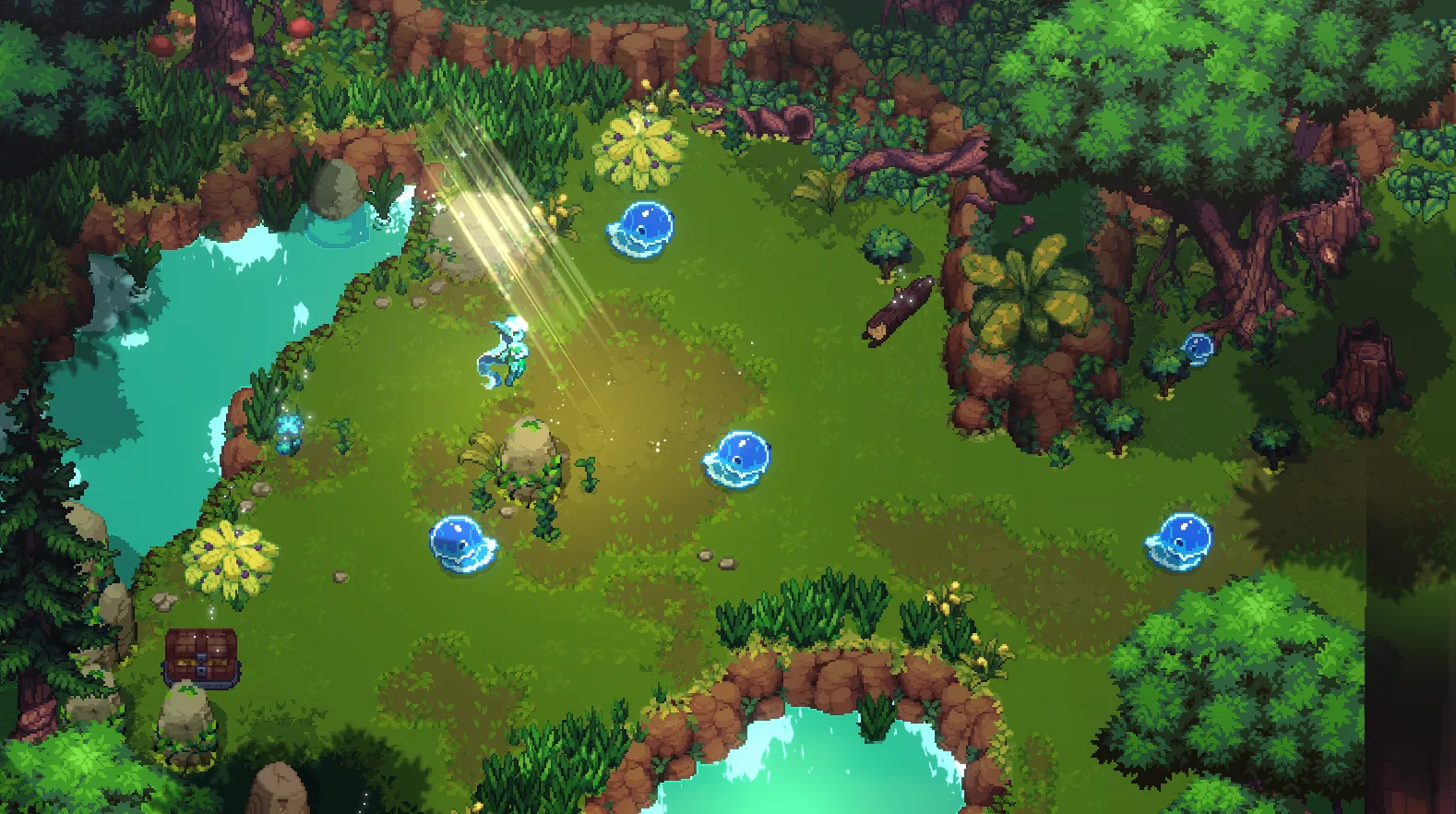
Short answer: Earlwood Village is Act 1's hub and the first town you reach. It is a town of outcasts roughly three hundred years old, standing between the Human Kingdom of Aldoria and the Eternal Forest. Most of it is sealed off when you arrive; the Guild Hall Quarter stays open.
Why Earlwood gets two official articles
Most regions in Dimraeth have a paragraph. Earlwood has two dedicated Mudtek posts — a narrative devlog from the game director and an art direction piece from the art director — which is the clearest signal of how much weight the studio places on the first town.
The game director is direct about why.
Official Devlog, 13 June 2025
“Earlwood was one of the first regions we built during early development. It anchors the opening act of the game, a place where the first threads of the story are woven.”
“For this first devlog, I want to introduce the first town region players will explore: Earlwood Village. A place of beauty and tragedy, and a fitting beginning for your journey through Dimraeth.”
Source: Mudtek Steam announcement, 13 June 2025 · verified 16 September 2026
A town of outcasts
The defining fact about Earlwood is not its location but who lives there.
Official Devlog, 13 June 2025
“Earlwood is unlike many places in Mirkea. It stands on the border between the Human Kingdom of Aldoria and the vast Eternal Forest, home of the elves.”
“Three centuries ago, it began as a lone homestead. Over time it became something more — a refuge for those cast out of their own lands. Here you'll find Minotaurs, Elves, Dwarves, and Humans, bound not by blood or crown, but by circumstance.”
“Earlwood is a town of outcasts, of those seeking a second life. That fragile kind of community carries its own quiet beauty.”
Source: Mudtek Steam announcement, 13 June 2025
Three things follow from that passage.
Earlwood is a border town. It sits between a human kingdom and an elven forest, which makes it a natural place for people who belong to neither.
Its population is unusually mixed. Minotaurs, Elves, Dwarves and Humans living together is described as “unlike many places in Mirkea”, and the devlog notes that “most of Mirkea remains divided along ancient lines. Earlwood stands apart.”
Its founding story is generational. Three hundred years from homestead to refuge means the town’s identity is inherited rather than recent. The people who live there now were born into a community their ancestors were exiled to.
That third point gives Earlwood its tension. A place built by outcasts is by definition a place whose residents did not choose each other, and the devlog frames the resulting peace as fragile: “such peace is never simple.”
The state you find it in
When you arrive, Earlwood is already unravelling. Most quarters are sealed by guards. Only the Guild Hall Quarter is open, and it is doing two jobs at once.
Official Devlog, 13 June 2025
“But such peace is never simple. And when players arrive, they'll find the village already caught in a slow unraveling.”
“Fear has gripped the town. Most quarters are sealed. The guards allow no one through. But not all obey. The Guild Hall Quarter remains open. It serves both as a refuge for the displaced and the village's last hope of defense.”
Source: Mudtek Steam announcement, 13 June 2025
That is an unusual starting position for a hub town. Rather than arriving in a safe base and watching it come under threat, you arrive after the threat has already landed. The sealed quarters mean the town you can access is a fraction of the town that exists — which also explains why everyone you meet is concentrated in one district.
The design goal is stated explicitly: “Here, we want players to feel the tension. The weight of what has been lost. The hope that still holds.”
The Earlwood Peninsula
The art director’s post explains where Earlwood physically is and why it looks the way it does.
Official Art director devlog, 21 August 2025
“The best example is Earlwood Village, the player's very first glimpse of the outside world. We wanted it to feel simple yet breathtaking — a quiet seaside settlement at the edge of the continent, far from the bustling cities of Mirkea, but unforgettable in its own right.”
“Location is the foundation of any environment, so we looked to real-world wonders for inspiration: the White Cliffs of Dover, the Fingal Caves of Scotland, and Vietnam's Ghềnh Đá Đĩa. Right away, it was clear Earlwood belonged on a dramatic coastal landscape like these. So we crafted a geographical location from these inspirations and produced matching fauna and flora. Earlwood Peninsula was born.”
Source: Mudtek Steam announcement, 21 August 2025
| Real-world inspiration | Location | What it likely contributes |
|---|---|---|
| White Cliffs of Dover | England | Pale cliff faces along the coast |
| Fingal Caves | Scotland | Sea caves in columnar rock |
| Ghềnh Đá Đĩa | Vietnam | Interlocking columnar basalt formations |
All three share a single geological feature: columnar basalt. That is a coherent choice, and it explains why the art director says it was “clear” Earlwood belonged on a coastal landscape like these — the three references reinforce one visual idea rather than three.
The location also sets the tone. “At the edge of the continent, far from the bustling cities of Mirkea” is a deliberate removal from the centres of power, which fits a town founded by people who were expelled from those centres.
The people and their architecture
The art director connects Earlwood’s culture directly to its geography.
Official Art director devlog, 21 August 2025
“The villagers draw on human traditions from Aldoria with a touch of Elven influence from their neighbors in the Eternal Forest. Their coastal home naturally shapes their way of life, which revolves around fishing, farming, logging, and trade.”
“Even their architecture reflects this connection. Homes and tools reuse materials salvaged from shipwrecks along the Earlwood Cliffs or repurposed parts from old boat production.”
Source: Mudtek Steam announcement, 21 August 2025
Two details are worth holding onto. The village’s economy is enumerated — fishing, farming, logging and trade — which matches what official screenshots show at a camp: planting beds, felled timber, stone workings and NPC crafters. Second, the architecture is salvaged: shipwreck materials and repurposed boat parts. That is a visual language for a poor community on a hostile coast, and the art director notes it was refined alongside the narrative director so the buildings would carry the village’s history.
Who you meet in Earlwood
The official website profiles six characters, and five of them are explicitly tied to Earlwood.
| Character | Role | Earlwood connection |
|---|---|---|
| Manga | Earlwood’s blacksmith | Lives in Earlwood; works from the Guild Hall |
| Befr | Travelling merchant | Caravan set up in Earlwood Village |
| Tamsin | Enchanter | Settled in Earlwood; uses the Guild Hall |
| Eldorian | Elven adventurer | Greets newcomers to the Guild Hall |
| Myrll | Exiled forest spirit | Lingers at the forest’s edge near Earlwood |
| Alaric | Folk hero | No Earlwood connection stated |
Manga’s entry is the one with the most setting detail.
Official Official website
“Once a warrior of the Minotaur Empire, Manga now lives a quieter life as Earlwood's blacksmith. Towering and calm, he's easily recognized by his cut-off horns — a mark of exile for refusing to join a brutal raid. Guided by the peaceful philosophy of Praesidiism, he believes true strength lies in protection, not conquest. Though his arrival was once met with distrust, Manga earned the village's respect through his skill, discipline, and bravery during the Goblin Crisis.”
Source: dimraeth.com · verified 16 September 2026
That passage does several things at once. It confirms the Minotaur Empire as an entity, introduces Praesidiism as a named philosophy, references a past event called the Goblin Crisis, and demonstrates how Earlwood’s culture works in practice — an exile arrives, is distrusted, and earns his place. Manga’s cut horns are a physical mark of his refusal, which makes the town’s identity visible on its residents.
The Goblin Crisis is also the second official reference to goblins, alongside the Goblin Caves added at Early Access and the “goblin king” named in the achievement list. Whether these are the same event and the same antagonists is not stated, and we do not connect them.
What is missing
Note Not published
Not published: Earlwood's location coordinates, the village layout, the names of the sealed quarters, which facilities you can build there, how many NPCs are recruitable in total, and the cause of the crisis the village is facing.
We also do not caption any screenshot as depicting Earlwood unless it carries an official label. Mudtek has published character art and unnamed scene art, but no captioned image of the village itself.
Checked against: 30 Mudtek announcements, Steam store page, dimraeth.com · 16 September 2026
Earlwood’s role in the loop
Mudtek frames the village not just as a story location but as a structural one.
Official Devlog, 13 June 2025
“Throughout the first act, you will return to Earlwood often. After forays into the wilds, you'll come back to share discoveries with familiar faces, craft new tools, and prepare for the road ahead. In this way, the village becomes both a sanctuary and a living thread through your journey — a place where relationships deepen, and where each return carries new meaning.”
Source: Mudtek Steam announcement, 13 June 2025
That describes the classic hub loop — venture out, return, restock, advance a relationship — and it confirms that relationships with Earlwood’s residents develop across Act 1 rather than resolving in one conversation.
For the forest Earlwood borders, see the Wildwood page. For the relationships the devlog mentions, see the romance and NPCs page. For the wider world these regions sit in, see the world and regions page.