Short answer: potions are Dimraeth's in-fight consumables. They recover Health, Concentration and Stamina quickly, some can be thrown to heal a teammate, some grant short damage buffs, and cures clear bleed and poison buildup before it snowballs.
What potions are for
Mudtek describes potions as the recovery half of the consumable system, and pairs that with a warning about supply.
Official Design post, 20 January 2026
“Health, concentration, and stamina can all be recovered quickly through potions, and if you want to rely on potions consistently, you'll want to maintain a healthy stockpile.”
Source: Mudtek Steam announcement, 20 January 2026 · verified 16 September 2026
Two things stand out. First, all three of Dimraeth’s core resources are recoverable this way — not just health. Stamina is the resource the combat system is built around, so a stamina potion is a way to keep attacking rather than a defensive crutch. Second, Mudtek frames the limiting factor as supply rather than power. The potion is not rare or gated; a consistent player simply maintains a stock of them.
That is the practical argument for the farming and crafting loop. Mudtek makes the connection explicitly: “if you keep a steady ingredient supply coming in through farming, you can turn basic materials into a reliable potion stockpile. Over time, potions stop being ‘rare loot’ and start being part of your standard prep before heading back out.”
Throwing potions at teammates
The most distinctive potion feature is one that only exists in co-op, and Mudtek describes it in detail.
Official Design post, 20 January 2026
“Potions also become a co-op tool. Some potions can be thrown, meaning if your friend is in trouble, you can literally throw them a heal mid-fight. In co-op, this creates those small save moments that stop a run from collapsing: a teammate gets clipped, their health drops, and instead of backing off and letting the fight spiral, you land a thrown potion and keep the team's momentum intact.”
Source: Mudtek Steam announcement, 20 January 2026
This is a genuine mechanical divergence rather than a flavour detail. In most action RPGs a healing item is a self-only action, which means a struggling teammate has to disengage to survive — and disengaging is often what causes a group fight to unravel. A thrown potion lets someone else solve that problem without you leaving the fight.
The design intent, in Mudtek’s words, is to preserve “momentum”. That is worth noting against the combat system’s emphasis on commitment and positioning: a run collapses when one player has to break their tempo, and the thrown potion exists to stop that.
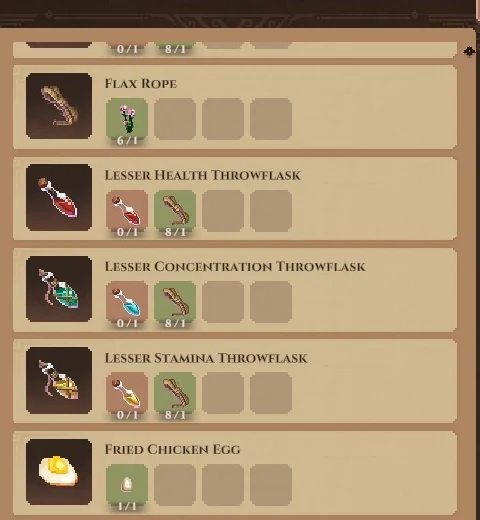
An official screenshot confirms the naming convention for this family. The inventory shows Lesser Health, Lesser Concentration and Lesser Stamina Throwflask items, which maps the three recoverable resources onto three distinct throwable flask types.
Cures
Cures are a separate category with a different job.
Official Design post, 20 January 2026
“Cures sit in a more specialised category. They matter most when you're taking on enemies that apply heavy bleed or poison buildup. In those cases, bringing cures is less about raw power and more about keeping control of the fight by clearing a dangerous buildup before it snowballs.”
Source: Mudtek Steam announcement, 20 January 2026
The word that matters is buildup. Bleed and poison in Dimraeth are accumulation mechanics rather than instant damage, which means they are dangerous in proportion to how long a fight runs. A cure is therefore a fight-length tool: it resets an accumulating threat rather than healing a fixed amount of damage.
This connects directly to the status effect system, where Mudtek describes stacking thresholds for other effects. Buildup implies a counter that fills, and cures are how you empty it deliberately instead of hoping the fight ends first.
Why cures are easy to undervalue. A cure does nothing visible in a short fight. Its value only appears when an encounter runs long enough for buildup to reach a threshold — which is exactly the situation where a run is most likely to be lost. If a boss applies heavy bleed, carrying cures is a preparation decision, not a reactive one.
Short-term damage buffs
Potions are not only defensive.
Official Design post, 20 January 2026
“On top of recovery, certain potions can provide short-term buffs as well, such as a minute of increased damage. The main split here is long-term versus short-term. Food is your long-duration baseline power. Potions are your burst sustain and burst buffs.”
Source: Mudtek Steam announcement, 20 January 2026
A one-minute damage window is a burst tool. Its natural use is a damage phase in a boss fight rather than general play, and it pairs with the food buffs that run for roughly thirty times as long. The two systems are designed to be stacked: food sets your baseline before you leave, and a potion provides a spike during the moment that matters.
Offensive tools
A third family covers gaps in a build rather than sustaining it.
Official Design post, 20 January 2026
“Crafting also gives you access to offensive tools like throwable knives and elemental flasks. These exist to supplement your build and cover gaps. If you're missing ranged pressure, area damage, or a reliable way to apply a certain status effect, offensive tools let you patch that weakness without having to rebuild your entire character around it.”
Source: Mudtek Steam announcement, 20 January 2026
That passage names three specific gaps these tools fill: ranged pressure, area damage and status application. The design philosophy is worth noting because it is the opposite of a class system. Rather than forcing a melee character to reroll for range, the crafting system provides a consumable answer.
Elemental flasks also connect to the resistance system. If food can grant elemental resistance, a flask that applies a status effect is the same idea pointed outward, and Mudtek’s earlier combat design post describes elemental interactions that chain between effects.
Potions in the consumable hierarchy
Pulling the families together gives a clear picture of what to carry.
| Consumable | Duration | Used | Primary job |
|---|---|---|---|
| Food | ~30 minutes | Before leaving base | Baseline stats and resistances |
| Recovery potions | Instant | During a fight | Restore Health, Concentration, Stamina |
| Throwflasks | Instant | During a fight | Same, but applied to a teammate |
| Damage potions | ~1 minute | On a damage window | Burst damage |
| Cures | Instant | When buildup is high | Clear bleed or poison buildup |
| Offensive tools | Instant | Situationally | Cover range, area or status gaps |
The pattern is that duration and urgency are inversely related. Food lasts longest and is consumed furthest from the fight; cures are instant and only matter at a specific moment. That is a useful way to plan a loadout, because it tells you which slots are baseline and which are response.
For how buildup and stacking actually work, see the status effects page. For the ingredient supply that keeps potions in stock, see the farming page. For throwing a heal at a teammate, see the multiplayer and co-op page.