Short answer: farming is deliberately simple. You build plots, plant seeds, and harvest when they mature. Beyond seeds you can build wells and animal or monster pens, which produce a steady trickle of basic resources so you stop gathering low-tier materials by hand.
Why farming is in the game
Farming exists to solve a supply problem, and Mudtek frames it in exactly those terms.
Official Design post, 20 January 2026
“Farming is one of the core tools for sustained production. If you want a steady supply of health potions, you will need a steady supply of ingredients, and that means farming. A simple example is tender berries: if they're part of your potion pipeline, you'll want them growing constantly so you're never bottlenecked.”
Source: Mudtek Steam announcement, 20 January 2026 · verified 16 September 2026
The chain is explicit: potions need ingredients, ingredients need a supply, and a supply means farming. The word “bottlenecked” is the key one. Farming is not about acquiring ingredients you lack; it is about removing the points where a shortage interrupts your prep loop.
That explains why the design is simple on purpose. A complicated farming system with tight timing would itself become the bottleneck.
How simple is it
Mudtek’s description of the mechanics is unusually short.
Official Design post, 20 January 2026
“Farming in Dimraeth is intentionally simplified. You build farming plots, plant seeds, and harvest them when they mature.”
Source: Mudtek Steam announcement, 20 January 2026
Three steps, no stated growth conditions. There is no mention of watering schedules, soil quality, fertiliser, seasons affecting growth, or crop rotation. Given that the studio lists seasons among the world’s features elsewhere, the deliberate omission of farming complexity here is a design choice rather than an oversight — the stated intention is that farming stays out of the way.
Note What is not published
Not published: the full crop list, growth times, seed sources, whether crops are seasonal, plot size limits, or how many plots a base can hold.
Tender berries are the only crop Mudtek names. A page that gives you growth timers for a dozen crops is not drawing on anything official.
Checked against: 30 Mudtek announcements, Steam store page, dimraeth.com · 16 September 2026
Beyond seeds: wells and pens
Farming extends past crops into passive resource production.
Official Design post, 20 January 2026
“Beyond seed plots, you can also build production structures such as wells and animal or monster pens. These provide a reliable stream of basic resources over time, so as the game progresses you're less reliant on constantly going out to gather low-tier essentials.”
Source: Mudtek Steam announcement, 20 January 2026
| Structure | Confirmed function | Confirmed status |
|---|---|---|
| Farming plot | Grow crops from seeds | Implemented |
| Well | Streams a basic resource over time | Implemented |
| Animal pen | Streams a basic resource over time | Implemented |
| Monster pen | Streams a basic resource over time | Implemented |
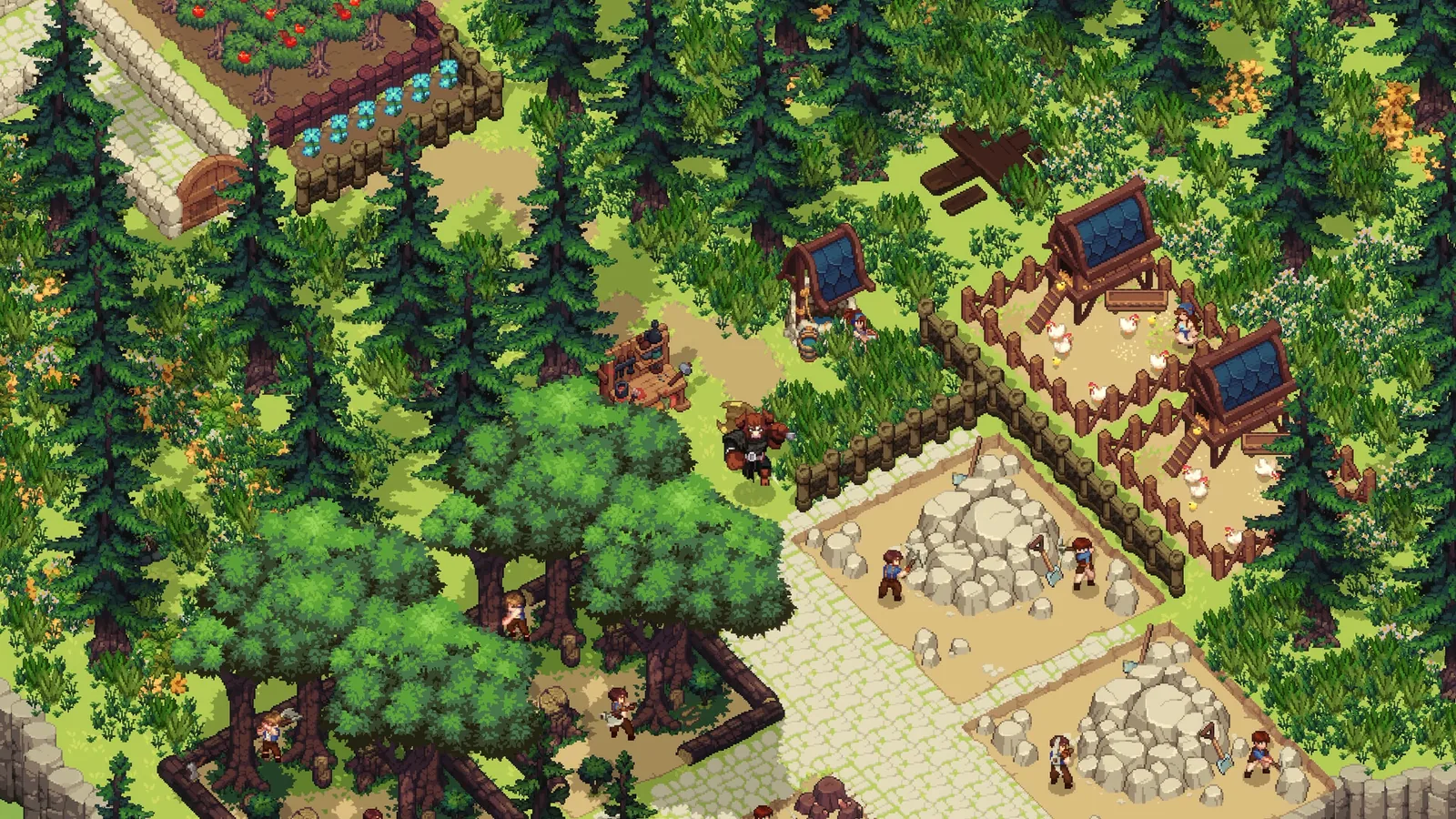
The phrase “animal or monster pens” is worth pausing on. Keeping monsters is a specific flavour choice, and the official Steam store screenshot of a camp shows a fenced enclosure standing beside planting beds, timber stacks and a stone quarry — a visual that matches Mudtek’s description of a settlement built around production.
The design logic across all four structures is the same: convert hand-gathering into passive income. Mudtek’s concern is “low-tier essentials”, which suggests the pens and wells exist so that basic materials stop competing for your attention once the game opens up.
The screenshot evidence
One official screenshot shows a working production camp, and it is the strongest visual support for how farming looks in practice.
| Visible in the image | What it indicates |
|---|---|
| Planting beds with crops | Farming plots in use |
| A fenced animal enclosure | An animal pen |
| Felled timber and logs | Logging as a production line |
| Exposed stone workings | Quarrying as a production line |
| NPC crafters at work | Facilities staffed by recruited allies |
We describe only what is visible. This screenshot is a camp scene and we do not claim it depicts any specific named location — Mudtek has not labelled it, and the official artwork does not confirm which settlement it is. It is representative of the system rather than a map of a particular place.
Achievement data on farming
Farming has a single dedicated achievement, and its completion rate is informative.
| Milestone | Achievement | Description | Completion |
|---|---|---|---|
| Harvest anything | Green Thumb | Harvest your first crop | 30.4% |
| Build a station | Tools of the Trade | Build your first crafting station | 56.2% |
| Upgrade a facility to maximum | Patron | Upgrade a facility to its maximum level | 9.7% |
30.4% places a first harvest firmly in the middle of the progression curve. It sits below building a crafting station (56.2%) and reaching level 5 (47.7%), and above recruiting a first ally to the Sanctum (20.0%). The reading is that farming is a normal mid-game step that a substantial share of players take, but it is not on the critical path the way the first crafting action is — “MacGyvered It” for crafting an item is at 100.0% by comparison.
The gap between 30.4% and the facility-upgrade figure of 9.7% is the more interesting number. It suggests many players start farming and few push the production side to its limits, which matches Mudtek’s own framing of crafting and building as optional.
Farming’s place in the loop
Farming is the supply stage of the consumable chain, and it pays off indirectly.
| Stage | System | Output |
|---|---|---|
| Supply | Farming plots, wells, pens | Ingredients and basic materials |
| Conversion | Cooking and alchemy | Food buffs, potions, cures |
| Application | Boss and elite fights | Resistance and stat breakpoints |
The store page confirms the same structure from the player’s side: “Build farms, quarries, and other structures for a steady supply of crops and raw materials.” Note that quarries appear in that list alongside farms, which is consistent with the camp screenshot showing stone workings next to planting beds.
For what the crops become, see the cooking page. For the potion pipeline that tender berries feed, see the potions page. For the buildings that house all of it, see the base building page.