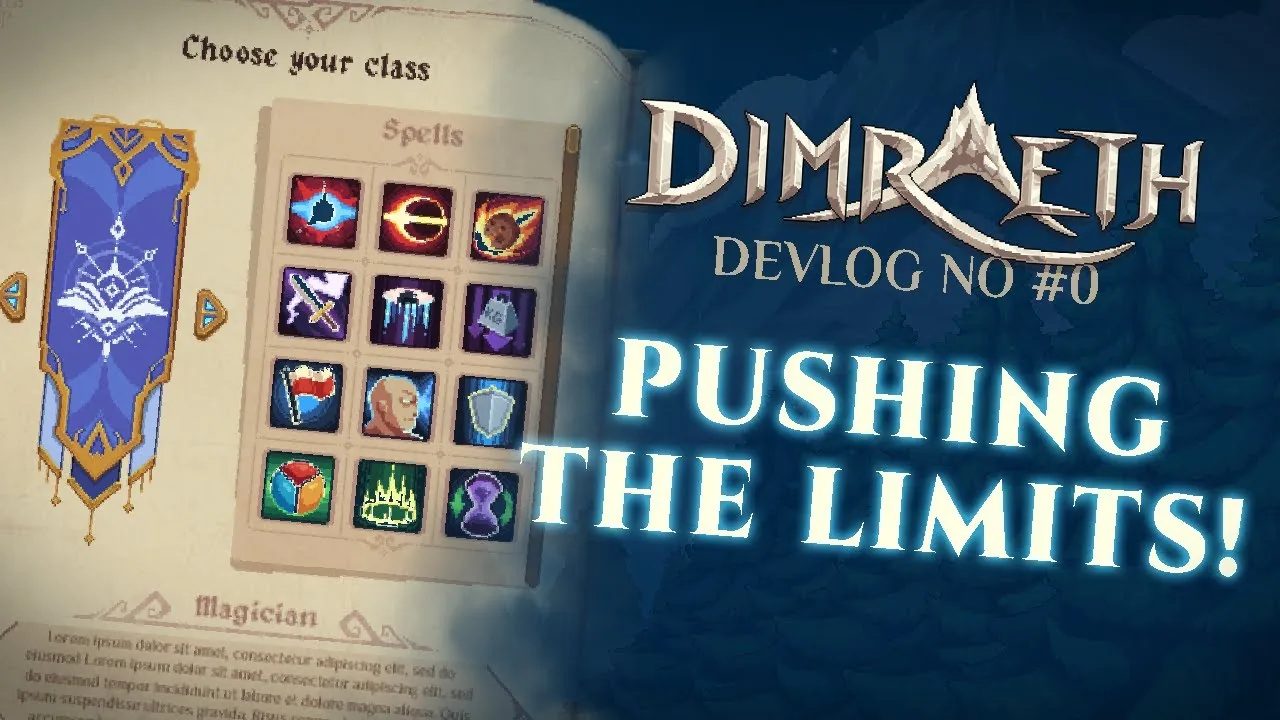
Short answer: you equip five spells at a time from a pool of more than 300. Spells come from three sources — your race, your class, and crafted spellbooks. The system is designed around chain interactions: applying a status with one spell, then consuming it with another.
The loadout rule
The store page states the constraint plainly, and the constraint is the whole design.
Official Steam store page
“Equip five spells at a time and build tactical rotations and combinations around your loadout. Your race and class offer their own spells, while crafted spellbooks grant access to universal magic, provided you meet each spell's attribute requirements. More than 300 spells are available in total.”
Source: Steam store page · verified 16 September 2026
Read the ratio: 300+ available, 5 equipped. The restriction is not a limitation to work around but the design’s primary tension. Mudtek says so directly in the combat devlog: “Though you’ll have many spells to choose from, your equipped slots are limited, so selecting the right set becomes a strategic decision.”
Five slots, four purposes. With five slots you cannot cover damage, control, sustain and utility simultaneously. Every loadout is a deliberate gap. That is the intent, not an accident of balance.
The three sources of magic
Spells reach you through three documented channels, and only one of them is archetype-exclusive.
| Source | Access rule | Exclusivity |
|---|---|---|
| Race | Available from character creation | Shared by everyone of that race |
| Class | Available from character creation | Shared by everyone of that class |
| Crafted spellbooks | Requires meeting the spell’s attribute requirements | Universal magic — available to any archetype that qualifies |
The third channel is the interesting one. Mudtek’s character-creation post states that “these archetype trees are where you’ll find spells and passives that no other archetype can use,” while the store page says spellbooks grant “universal magic” subject to attribute requirements. So the archetype tree is the exclusive channel, and spellbooks are the open one.
That has a direct build implication. If a spell you want is not in your archetype tree, the path to it runs through a spellbook and the attribute investment needed to qualify.
Spellbooks come from your settlement
The spellbook channel is not a shop. Mudtek ties it to recruited NPCs and monster materials.
Official Design post, 20 January 2026
“As you recruit NPCs into your settlement, some of them will be able to craft spell books for you based on materials you gather from monsters and bosses. These spells are almost always reflections of the creature you took the materials from, and they can become a major pillar of your build once you unlock them.”
“Unlocking more spell books through these NPCs is tied to broader progression. As you complete quests and push the main story forward, you'll gain access to more options, deeper spell pools, and more ways to shape the direction of your character.”
Source: Mudtek Steam announcement, 20 January 2026 · verified 16 September 2026
Three consequences, all stated or directly implied:
Killing bosses feeds your spell list. Materials from monsters and bosses are the input. This gives boss encounters a progression payoff beyond equipment.
Themes come from the source creature. “Reflections of the creature you took the materials from” means spellbooks are thematically tied to their origin, not generic.
Recruiting NPCs is a spell-access system. This is why the Sanctum matters for builds, even though only 20.0% of tracked players had recruited their first NPC at achievement capture time.
Chain interactions: the core design idea
The clearest statement of how spells are meant to combine comes from the combat devlog, which describes spells as pieces of a puzzle rather than independent buttons.
Official Combat devlog, 18 July 2025
“Do you ignite enemies with fire and follow up with an inferno? Stack bleed effects with your teammate to trigger an execution finisher? Layer frost on an enemy and then freeze them in place with a javelin of ice? Every spell is part of a greater puzzle — each one a piece of possibility, not a one-off button.”
Source: Mudtek Steam announcement, 18 July 2025 · verified 16 September 2026
That single paragraph documents three distinct combo patterns.
| Pattern | Setup | Payoff | Requires |
|---|---|---|---|
| Fire | Ignite with fire | Inferno follow-up | One player |
| Bleed | Stack bleed effects | Execution finisher | A teammate — Mudtek specifies co-operative stacking |
| Frost | Layer frost | Freeze with an ice javelin | One player |
The bleed example is notable because Mudtek states it as a co-operative action: “stack bleed effects with your teammate.” That is the same design logic as the archetype co-op example, where one player applies a status and another converts it.
The devlog summarises the intent: spells are “designed around chain interactions and status synergy to allow for rich and expressive builds.”
Elemental identity
Fire, ice and lightning are the elemental triad named in the Magician’s official class description: “the ability to summon fire, ice, or lightning, they adapt their tactics to exploit enemy weaknesses.”
That establishes two things. First, enemies have weaknesses worth exploiting, and second, the Magician is designed around adapting to them rather than committing to one element. The combat devlog adds that enemies “signal their attacks with readable wind-ups,” and the crafting post describes scouting a boss’s “damage profile” before preparing.
Note Elemental resistance
Food buffs can grant elemental resistances, and Mudtek frames this specifically as preparation for “a boss with a specific damage profile.” That confirms resistances are a tracked defensive stat on both sides of the fight.
Source: Mudtek Steam announcement, 20 January 2026
Spell upgrades
Spells can be upgraded. Mudtek's patch notes for the 5 October 2025 build include a fix for “spell upgrades and passive set bonuses to properly show in the stats UI” — which confirms both systems exist as distinct mechanics.
The same patch note thread mentions a fix for “spell haste not showing up,” indicating that cast speed is a modifiable spell attribute. Neither system has published numbers.
On “best spell” lists. With no published damage values, cast times or cooldowns for individual spells, any ranked spell list for Dimraeth is unsourced by definition. What can be reasoned about is structure — how many slots you have, what each source provides, and which chain interactions the developer has named.
Building a loadout
The official material supports a structured approach even without numbers.
1. Count your roles, not your spells. Five slots have to cover damage, status application, status consumption, sustain and defence. If one slot is doing two jobs, the others must compensate.
2. Pick a chain, then fill the rest. Mudtek’s three examples are self-contained patterns: ignite then inferno, frost then freeze, bleed then execute. Committing to one chain is more coherent than taking five unrelated strong spells.
3. Check which spells are exclusive to you. Archetype tree spells are unavailable to other pairings. Spells from your archetype tree are the tools that make your build distinctive.
4. Plan attributes for any spellbook spell. Spellbooks are gated by attribute requirements, and attribute costs vary by race–class combination. A spellbook spell is therefore cheaper for some archetypes than others.
5. Remember casting costs stamina. Every cast competes with your dodge and your attack for the same pool. A five-spell rotation that consumes stamina faster than you regain it is not a rotation.
For how these spells apply their statuses and what the stacking rules appear to be, the status effects page collects what is documented.