Short answer: you build on a tile-based isometric grid, for both function and decoration. Functional building covers crafting stations, farms, pens, production buildings and a Waypoint. You also recruit NPCs into your Sanctum and invest materials in their facilities to unlock shops, services and more farm plots.
What building is for
Mudtek describes building as the system that supports long-term production, and separates its two purposes clearly.
Official Design post, 20 January 2026
“The primary purpose of building is to establish your item pipeline. If you want steady access to the things that make your character stronger, you will need to build the stations, farms, and storage to keep production running.”
“The loop is straightforward: you return to base, you restock, you queue up items for your next adventure, and you gradually expand your base so that it supports more recipes, more farming output, and more long-term convenience. Over time, your base becomes the backbone of your progression outside combat.”
Source: Mudtek Steam announcement, 20 January 2026 · verified 16 September 2026
The phrase “backbone of your progression outside combat” is the studio’s own summary of how important the base is. It is not a side activity; it is where the consumable and equipment pipeline lives.
Note also the three things expansion buys you, in Mudtek’s own ordering: more recipes, more farming output, and more long-term convenience. That maps directly onto the crafting, farming and quality-of-life systems.
The decorative half
Building is not only functional, and Mudtek is unusually explicit about the parallel purpose.
Official Design post, 20 January 2026
“Building also has a purely decorative side. We have a full isometric, tile-based building system for players who want to create their dream pixel art home. That includes furniture, wall decorations, rugs, lighting, and more. If you want to treat your base like a functional production hub, you can. If you want to treat it like a cosy creative project, you can do that too.”
Source: Mudtek Steam announcement, 20 January 2026
Three details are worth extracting. The grid is tile-based and isometric, which is a specific structural choice rather than free placement. The decorative catalogue is enumerated — furniture, wall decorations, rugs, lighting — which tells you the wall and floor layers are both buildable. And the furniture category was listed again in the September 2026 Early Access content update, so the decorative set shipped.
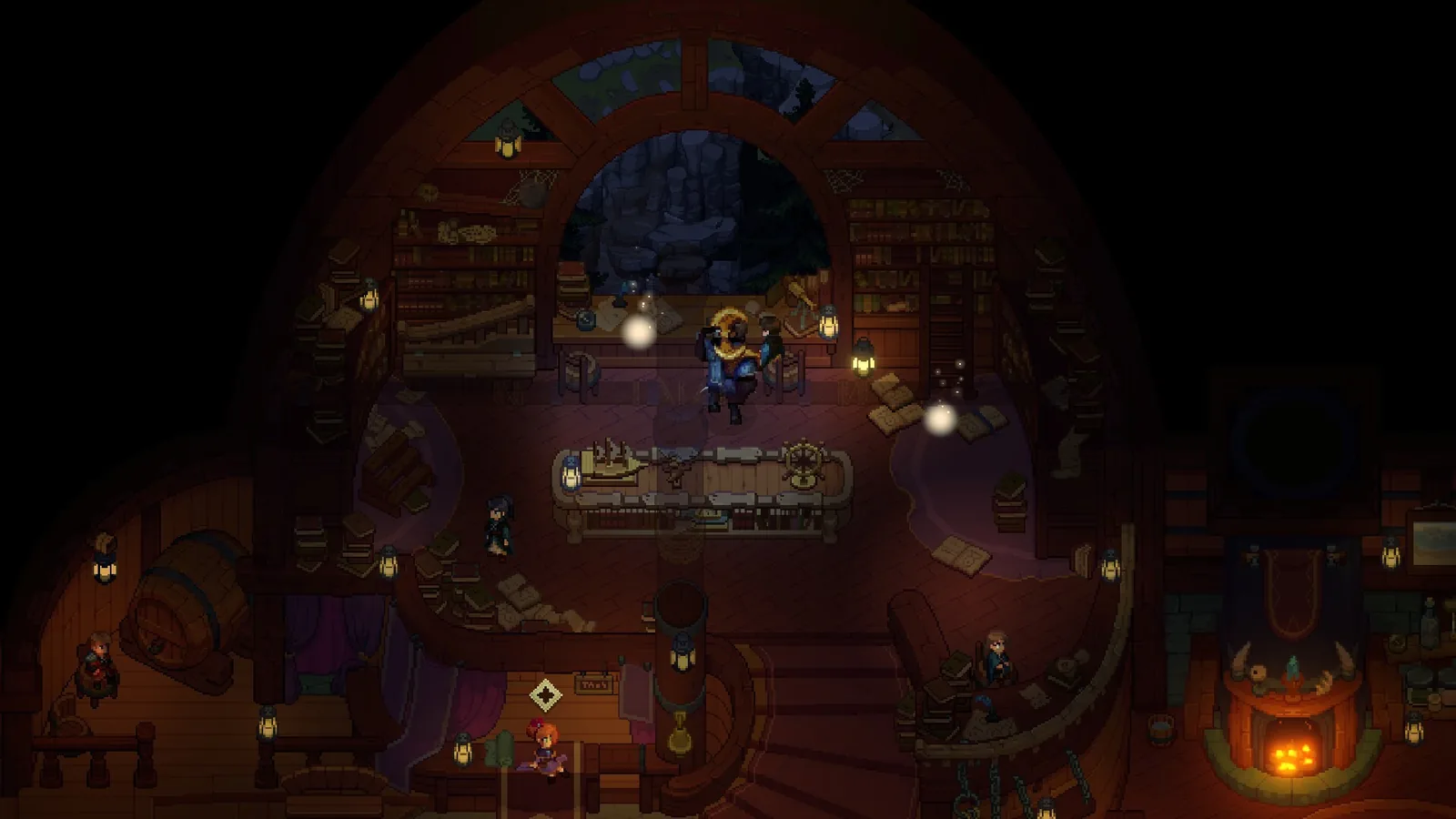
An official screenshot shows an interior with arched windows, full bookshelves, hanging lanterns and a counter, which is consistent with a decorative system that reaches interiors rather than just exteriors.
The Sanctum and recruiting allies
The Sanctum is where the settlement’s capabilities come from, and the achievement list gives it official standing.
Official Achievement descriptions
A New Ally — “Recruit your first NPC to the Sanctum” — 20.0%
Sanctum Society — “Recruit 5 NPCs to the Sanctum” — 0.0%
Source: Steam achievement page · verified 16 September 2026
The Sanctum is therefore a physical place you recruit people into, not an abstract reputation track. Two data points stand out. First, only 20.0% of tracked players have recruited even one ally, which places it well after farming a first crop (30.4%) and reaching level 5 (47.7%). Second, the 20.0% to 0.0% drop means recruiting five is effectively a completionist goal — the figure rounds to zero.
That is a striking distribution for what sounds like a core system. Either recruitment is gated behind significant progression, or most players simply never reach it in the tracked window. The achievement data cannot distinguish between those explanations, and we do not guess.
Practical consequence. If recruiting allies is why you want to build, expect it to be a mid-game goal that the majority of players never reach. The 0.0% on recruiting five is the clearest signal that the Sanctum is a long-term project rather than something you fill out early.
Facility investment
Facilities are how a recruited ally becomes useful, and the store page describes the mechanic precisely.
Official Steam store page
“Invest materials in your allies' facilities to expand shop inventories, add new crafting services, and open more farming plots. Every journey leaves your hero stronger and your home more complete.”
Source: Steam store page · verified 16 September 2026
| Investment result | Effect on your game |
|---|---|
| Expanded shop inventories | More items purchasable from NPCs |
| New crafting services | Additional recipes or stations available |
| More farming plots | Higher ingredient throughput |
Two structural points emerge. Facility investment is material-driven rather than currency-driven — you spend resources you gathered, which ties the settlement to your exploration. And it is the mechanism by which the NPC purchase route from the crafting system scales: if you chose not to craft and rely on buying supplies at a premium, investing in facilities is how that inventory grows.
Facilities also have levels. The achievement Patron — “Upgrade a facility to its maximum level” — sits at 9.7%, which is higher than recruiting a first ally (20.0%) in the sense that fewer players do it, and it confirms that individual facilities cap out.
Waypoints and production buildings
Two achievement descriptions supply the rest of the official building vocabulary.
| Structure | Achievement | Description | Completion |
|---|---|---|---|
| Waypoint | Wayfarer’s Gate | Build a Waypoint | 5.1% |
| Production buildings | Industrialist | Build 7 different production buildings | 0.0% |
| Crafting stations | Workshop | Build a Workbench, an Alchemy Table and a Woodfire Stove | 0.3% |
A Waypoint is a buildable structure rather than a fixed map feature, which is a meaningful distinction. At 5.1% it is a mid-to-late game construction, and it is the only structure in the achievement list whose name implies travel rather than production. Mudtek has not published what building one does, so we describe it as a buildable structure and stop there.
Industrialist confirms that production buildings are a counted category with at least seven distinct types, and Workshop confirms three named crafting stations. Together they establish that the buildable catalogue includes both production and crafting structures, which is consistent with Mudtek describing stations as the thing that expands your recipe pool.
The completion figures here are worth reading as a group: 0.0%, 0.0%, 0.1%, 0.3%, 5.1%. Almost every construction achievement sits at the very bottom of the list. Building a full settlement is the least-completed activity in the game.
How the base interacts with co-op
This is the point where many players will be surprised, and it comes straight from the store page.
Official Steam store page
“Your hero's level, equipment, inventory, spells, and personal progression travel between worlds, while story progress, recruited allies, and buildings remain tied to each world.”
Source: Steam store page
Buildings and recruited allies are explicitly on the world-bound side of that split. If you join a friend’s game, you bring a developed character but not your base, and you will see their settlement rather than yours. Building is a per-world project by design.
That has a practical implication for groups: if several players want a shared home base, they need to settle on one world and build there together, because the base does not follow the individual.
Note Not published
Not published: building material costs, the full structure list, plot or land limits, whether there are multiple base locations, whether buildings can be moved or demolished for partial refund, and whether more than one player can build simultaneously in a shared world.
Checked against: 30 Mudtek announcements, Steam store page, dimraeth.com · 16 September 2026
Where building fits
Building sits at the centre of the non-combat half of Dimraeth, and the achievement data shows that most players only touch its edges.
| Layer | What it provides | Best completion |
|---|---|---|
| Crafting stations | More recipes | 0.3% (all three stations) |
| Farming | Ingredient supply | 30.4% (first harvest) |
| Facility investment | Shops, services, more plots | 9.7% (max a facility) |
| Sanctum allies | Labour for the above | 20.0% (first recruit) |
| Production buildings | Passive resources | 0.0% (seven buildings) |
| Waypoints | A buildable travel structure | 5.1% |
The spread tells a consistent story. Harvesting a crop is a thing a third of players do. Building a settlement is something almost nobody completes. Whether that is because the systems are deep, gated late, or simply optional — Mudtek’s stated design is that they are impactful but not essential — the numbers say there is a lot of untouched content here.
For the consumables your base produces, see the crafting, cooking and potions pages. For the ingredient supply, see the farming page. For what happens after the story ends, see the endgame page.