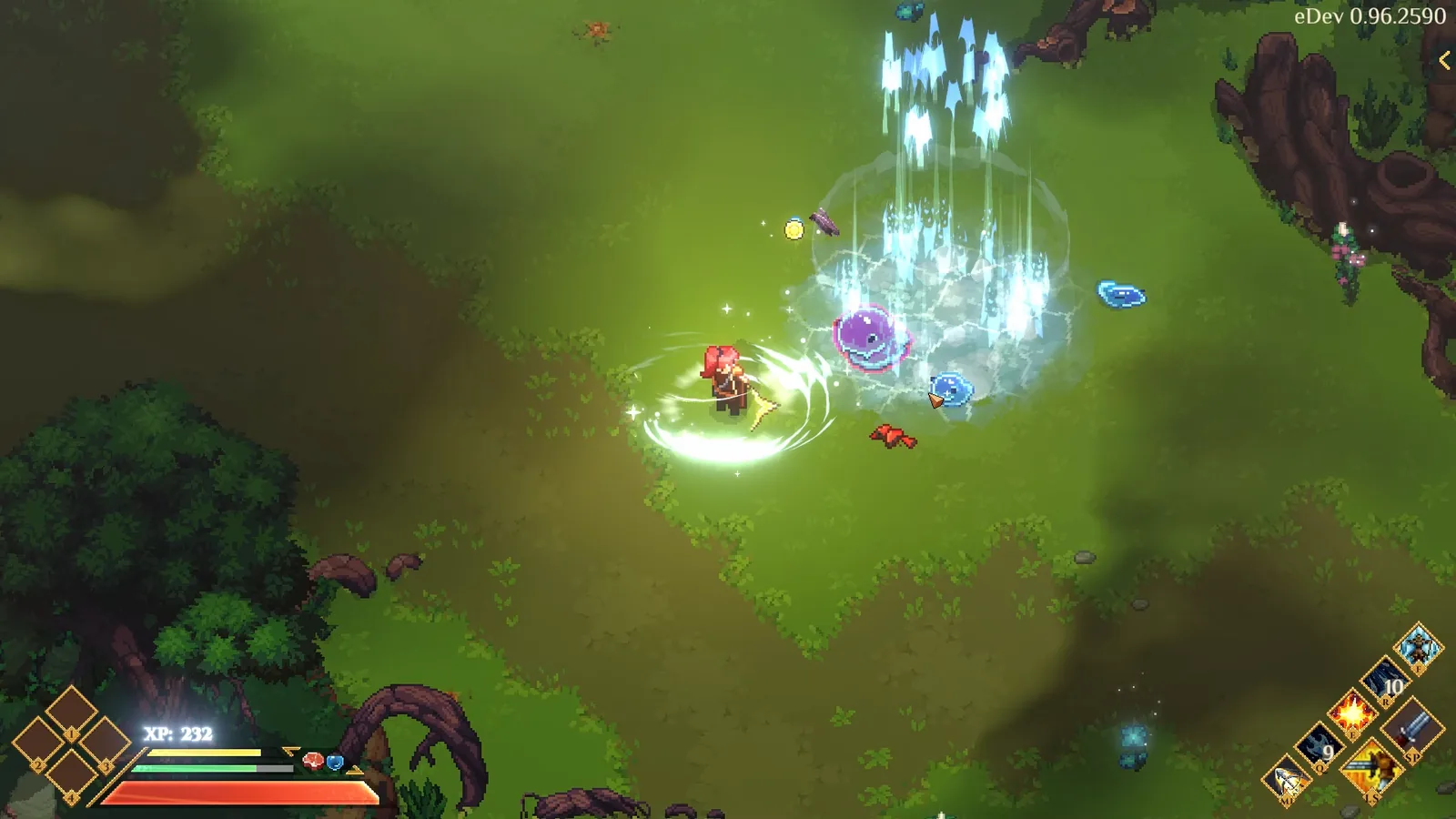
Short answer: build around your archetype's exclusive tools, commit to one or two chain interactions, and spend XP in line with your passive's primary attribute. We do not publish a best-build ranking, because Mudtek has not released any damage values to rank.
Why this page has no tier list. Tier lists require measured performance. Mudtek has published no damage numbers, no stat tables, no cooldown durations and no enemy health values for Dimraeth. Several sites currently rank Dimraeth classes and builds anyway; whatever method they used, it was not comparison against published data. This page explains the systems instead.
The four levers of a Dimraeth build
Every build decision in Dimraeth comes from one of four systems, and all four are documented officially.
| Lever | What it controls | Set at |
|---|---|---|
| Archetype | Your exclusive tree — spells and passives nothing else has | Character creation |
| Archetype passive | Which attribute gives the most value per point | Character creation |
| Attribute spend | Which spells and items you qualify for | Ongoing, costs XP |
| Spell loadout | Your active five — and therefore your chain | Ongoing |
The two at character creation are the foundation; the two ongoing are where a build becomes specific. Because the foundation is a race-and-class pairing, the first question any build guide should answer is which archetype, not which class.
Lever 1: the archetype tree
Mudtek states that each archetype tree holds “spells and passives that no other archetype can use” and calls those the “anchor of your build: the core set of tools, synergies, and power spikes that you will build around.”
That makes the tree the starting point. Everything available from your race, your class, or a crafted spellbook is also available to someone else in some form. The tree’s exclusives are what make your build yours.
Note Practical implication
Because trees are per archetype rather than per class, two players running the same class with different races have different exclusive tools. A build described as “a Brawler build” is under-specified; it needs the race to be meaningful.
Source: Mudtek Steam announcement, 16 November 2025
Lever 2: the archetype passive
Each archetype has one passive that adds an extra benefit to a single attribute. Mudtek’s example is the Minotaur Brawler, a Vanguard archetype, which “gains bonus stamina whenever they level Strength, whereas other archetypes do not.”
The official framing is that this creates a primary attribute — “the attribute that gives you the most value per point” — without removing your ability to experiment.
| Archetype | Official name | Passive effect stated |
|---|---|---|
| Minotaur Brawler | Vanguard | Bonus stamina when levelling Strength |
| Minotaur Mage | Earthshaker | Spreads fire; procs passives when enemies are Burning |
| Human Mage | Elemental Ranger | Converts existing fire into single-target damage |
Only the Minotaur Brawler’s passive is described in passive terms. The other two are described through combat behaviour, which is a different quote from the same post — we reproduce them as Mudtek wrote them, without extending the description.
Lever 3: attribute spending
This is where most builds are won or lost, and it is unusual enough to explain carefully.
Official Design post, 16 November 2025
“It costs XP to level up your attributes. The XP cost of each attribute is primarily determined by your race–class combination … if you spend a lot of XP pushing into your ‘off’ stats, you will end up with fewer total attribute points by the time you reach max level.”
“You will need to manage breakpoints and plan around specific spells or items you care about.”
Source: Mudtek Steam announcement, 16 November 2025 · verified 16 September 2026
Three rules to build with:
Prices differ by pairing. There is no universal cost per attribute point. The same point costs more for some archetypes than others.
The budget is finite. Off-stat investment reduces total points at max level. Attributes are a pie, not a ladder.
Breakpoints are the real target. The useful unit is not “more Strength” but “enough Strength for this spell.” Mudtek names the pattern directly: plan around specific spells or items.
Attribute respec is unconfirmed. Skill points can be reset — the SKILL TREE screen shows a Respec option. Mudtek has not said whether attribute points can. Until that is confirmed, treat your first attribute allocation as provisional and lean on the primary attribute your passive rewards.
Lever 4: the five-slot loadout
The store page states: “Equip five spells at a time and build tactical rotations and combinations around your loadout.” Mudtek’s devlog adds: “selecting the right set becomes a strategic decision.”
Five slots is the hard constraint that shapes everything else. Work through it honestly:
| Role | Typical slots needed | Note |
|---|---|---|
| Status application | 1 | The setup half of a chain |
| Status payoff | 1 | The trigger half of a chain |
| Main damage | 1–2 | Not every build needs two |
| Sustain or defence | 1 | Cures, recovery or mitigation |
| Flex | 0–1 | Where your archetype’s exclusive spell goes |
That budget is tight on purpose. A committed chain costs two of five slots before you have covered damage or sustain.
The chains to build around
Mudtek names three chain interactions in the combat devlog. Each is a two-spell pattern and each is documented.
| Chain | Setup | Payoff | Mudtek’s exact framing |
|---|---|---|---|
| Fire | Ignite with fire | Inferno | “ignite enemies with fire and follow up with an inferno” |
| Frost | Layer frost | Freeze with an ice javelin | “layer frost on an enemy and then freeze them in place” |
| Bleed | Stack bleed effects | Execution finisher | “stack bleed effects with your teammate” |
The bleed chain is the outlier: Mudtek specifies that it is stacked with your teammate, which makes it a party-level build rather than a personal one.
Co-op builds: the Burning engine
The most detailed build example Mudtek has published is a two-player synergy, and it is worth studying as a template for how co-op building works.
Official Design post, 16 November 2025
“One player might build a Minotaur Mage (Earthshaker) around spreading fire and proccing passives whenever enemies are Burning, while another builds a Human Mage (Elemental Ranger) that turns any existing fire on the field into high-impact single-target nukes. The result is a party that doesn't just ‘have two mages,’ but a coordinated Burning engine.”
Source: Mudtek Steam announcement, 16 November 2025 · verified 16 September 2026
Three structural lessons transfer to any pair:
Role split by function, not by class. Both players are mages. The split is applier versus converter.
Each build covers the other’s weakness. One spreads status broadly; the other focuses it into single-target damage.
The synergy is archetype-specific. This requires a Minotaur and a Human, not two of either. Race is part of the build.
Note Why race matters here
Mudtek notes that in co-op, “the archetype trees and attribute scaling are where party identities come from.” Because each race–class pairing has its own tree, party composition is a question about pairings, not classes.
Source: Mudtek Steam announcement, 16 November 2025
Where the rest of your build comes from
Spells are one of three ways a build grows. The other two are gear and the settlement.
Gear. The FORGE screen has UPGRADE and SALVAGE tabs, and an official screenshot shows an upgrade changing attack speed from 4.0 to 4.2 alongside resistance values. Mudtek also references “passive set bonuses” in patch notes, so equipment sets contribute passives. Equipment crafting is not implemented yet — drops remain the primary loot path.
Spellbooks from your settlement. Mudtek states that recruited NPCs can craft spellbooks from materials gathered from monsters and bosses, and that “these spells are almost always reflections of the creature you took the materials from.” That makes the Sanctum a build system, not only a base system.
Food buffs. Percentage-based and timed, averaging around 30 minutes, covering max health, max stamina, concentration, regeneration and elemental resistances. Mudtek frames these as boss preparation.
Caution Demo-era numbers
Community wikis carry figures such as “46 spells” and “48 recipes” from the Dimraeth demo. Those describe a build of the game that Mudtek removed in July 2026 and that the studio said had diverged significantly from Early Access. We do not use demo-era counts as current figures.
Sources: community wiki archives · Mudtek announcement, 2 July 2026
A build-planning sequence
Ordered by how much each decision constrains the next.
- Pick the playstyle. Race sets your base kit — frontline, kiting or backline — and class cannot override it.
- Pick the pairing whose exclusive tools you want. Read the archetype tree as a set of things nothing else can do.
- Note the primary attribute. The passive points at it; XP costs reinforce it.
- Choose one chain, or two if the pairing supports it. A chain costs two of five slots.
- Reserve a sustain or defence slot. Damage you cannot survive is not damage.
- Plan attributes to breakpoints, not to maximums. Identify the specific spells or items you are aiming to qualify for.
- In co-op, agree who applies and who converts. The official examples all follow this division.
If you want to know which archetypes exist and which Mudtek has named, the archetypes page lists all nine launch pairings and flags the six that remain unnamed officially. For the constraints on what you can carry, the spells page covers sources and slot budget.