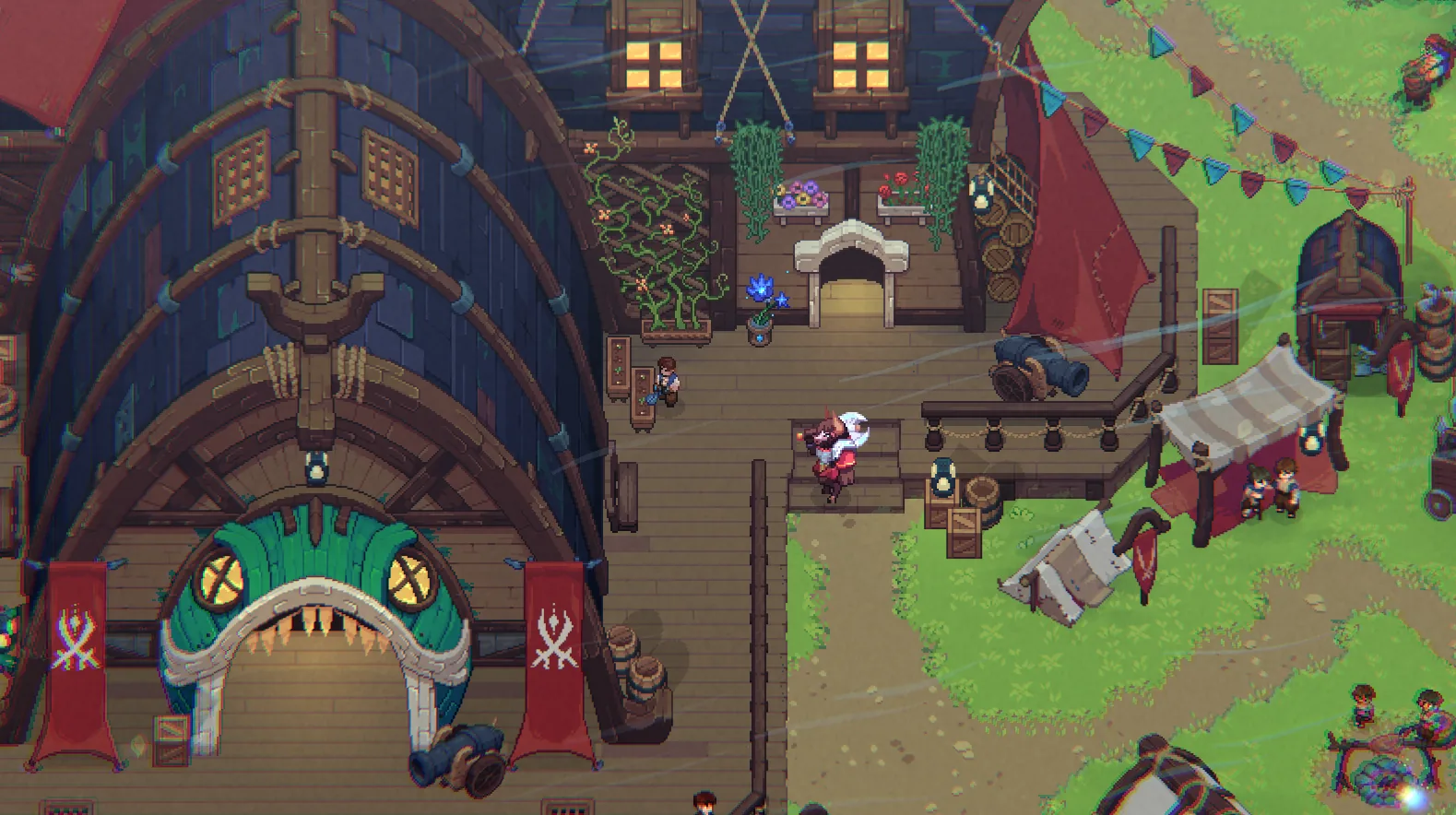
Short answer: Dimraeth blends Souls-lite combat, deep character progression and crafting with base building in a handcrafted pixel-art world, playable alone or with up to seven others. If you like the expedition-and-return rhythm of games like Valheim or Enshrouded but want ARPG combat and a fixed world, it sits in that space.
How Mudtek describes it
The studio’s own genre label is the best starting point, because it names three separate traditions in one sentence.
Official Steam store page
“Dimraeth is a hybrid action RPG blending deliberate Souls-lite combat and deep character progression with crafting and base-building.”
Source: Steam store page · verified 16 September 2026
Three traditions, and the word “hybrid” is doing the work.
| Tradition | What Dimraeth takes from it | Evidence |
|---|---|---|
| Souls-lite | Stamina management, telegraphs, commitment per attack | Combat design devlog |
| ARPG | Character builds, skills, loot-driven power | 48 archetypes planned, 300+ spells |
| Survival crafting | Farming, cooking, potions, base building | Crafting and building design post |
That combination is the useful thing to compare against other games, because most titles only do two of the three.
Compared with Valheim
Valheim is the comparison readers reach for most often, and the overlap is real.
Both games build their loop around leaving home, gathering, and returning to improve a base. Both support small-group co-op. Both treat food as a real system rather than a cosmetic one.
| Dimension | Dimraeth | Valheim |
|---|---|---|
| Combat | Souls-lite, stamina-gated, telegraphed | Melee and ranged with stamina |
| World | Handcrafted pixel art | Procedural, biome-based |
| Theme | Dark fantasy, corruption and gods | Norse mythology |
| Progression | Races, classes, archetypes, skill tree | Skills that level through use |
| Building | Isometric tile grid | Freeform structural building |
| Food | Timed percentage stat buffs | Health and stamina over time |
The clearest divergence is the world. Valheim generates a fresh world each run; Dimraeth’s world is handcrafted, which means the regions are authored rather than seeded. The second is combat: Dimraeth gates your options behind stamina and asks you to commit to one action at a time, which is a different feel from Valheim’s more forgiving exchange.
The building difference is also structural rather than cosmetic. Dimraeth uses an isometric tile grid, which makes it a placement system rather than a structural engineering one.
Compared with Enshrouded
Enshrouded shares Dimraeth’s ambition to combine action combat with a buildable base.
| Dimension | Dimraeth | Enshrouded |
|---|---|---|
| Building | Isometric tile grid, interior and exterior | Voxel-based, destructible |
| Party size | Up to 8 | Small-group co-op |
| Combat | Stamina-gated, parry and guard | Action combat with skill trees |
| World | Handcrafted pixel art | Voxel fantasy world |
The building system is where they feel most different. A voxel world lets you carve and reshape terrain; Dimraeth’s tile grid is closer to furnishing and extending a settlement. If shaping the landscape is the appeal, that is a meaningful difference.
Compared with ARPGs like Diablo
If you come to Dimraeth from the ARPG tradition, the combat will feel slower on purpose.
| Dimension | Dimraeth | Diablo-style ARPG |
|---|---|---|
| Resource | Stamina gates every action | Mana or cooldowns |
| Defensive options | Dodge, block and parry as choices | Mostly positioning and cooldowns |
| World | Fixed and handcrafted | Often procedural |
| Settlement | Buildable base and recruited allies | Usually a static hub |
| Group size | 1–8 drop-in | Typically 1–4 |
Mudtek is explicit that attacking is a commitment rather than a default. In the combat design post the studio frames the choice as: “Manage your stamina, read enemy telegraphs, and position yourself before choosing to strike, dodge, block, or parry.” That is a Souls-lite sentence, not a Diablo one.
Compared with narrative RPGs
If what draws you is character work rather than combat, Dimraeth’s offering is still developing.
Party-based narrative RPGs are built primarily around companions and dialogue. Dimraeth has six officially profiled characters, a designed relationship system, and a stated intent to include romance — but Mudtek’s September 2025 playtest summary said there were no romance questlines or payoffs at that point, and the Early Access feature list does not name romance.
So if relationship content is your main motivator, treat Dimraeth as a game to watch rather than one to buy right now. If it is combat, build crafting and co-op, there is a substantial amount already.
What is genuinely distinctive
Setting comparisons aside, four things in Dimraeth have few direct equivalents.
| Feature | Why it stands out |
|---|---|
| 48 archetypes | Any race with any class, each pair with its own skill tree |
| 300+ spells | Five equipped at a time, with attribute requirements |
| Thrown potions | Heal a teammate mid-fight without disengaging |
| Isometric tile building | Both functional production and full decoration |
The archetype system is the headline claim, and it comes from Mudtek’s own store page: “Combine any of eight races with any of six classes to create 48 distinct Archetypes. Each pairing has its own skill tree and playstyle.” The important caveat is that Early Access shipped with three races and three classes — 48 combinations is the destination, not the current state.
For what is actually in the build, see the Early Access content page. For how the combat feels in practice, see the combat guide. For how co-op changes the experience, see the multiplayer and co-op page.
Note On comparisons
Comparisons above use broad, stable descriptions of each game's approach. Games change during their own development, so check each title's own store page for current specifics. Every claim about Dimraeth on this page is sourced from Mudtek material.
Dimraeth sources: Steam store page, Mudtek design posts of 18 July 2025 and 20 January 2026