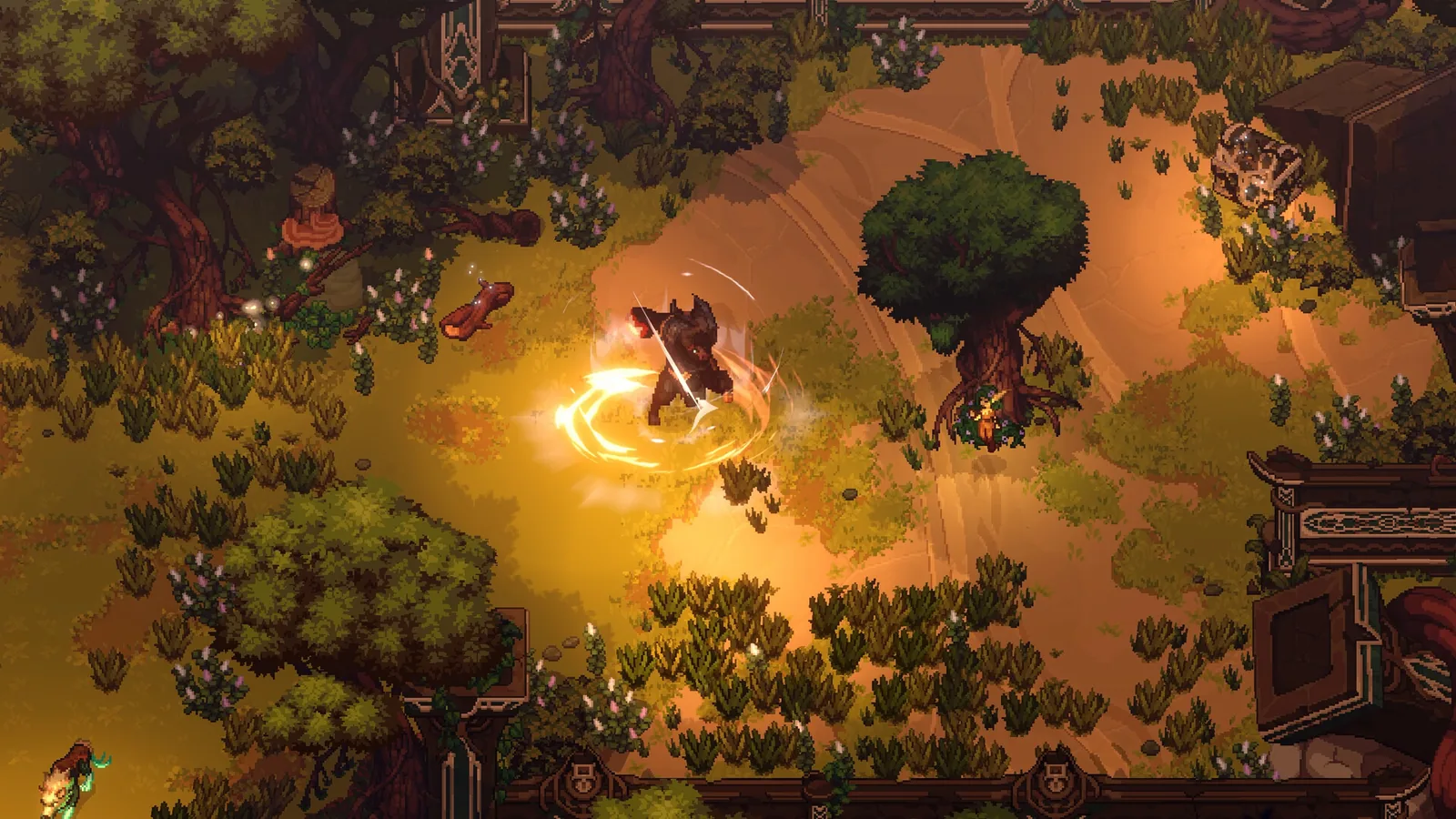
Short answer: combat is built on three pillars — defense, attacks and spells. Every character has a standard dash and a race-specific guard, both on their own cooldowns, and casting, blocking, dodging and striking all draw from the same stamina pool. Enemies telegraph their attacks, so reacting in time is the deciding skill.
What Dimraeth combat is trying to be
Mudtek’s combat devlog names its inspirations openly, and the list is more specific than the usual marketing language.
Official Combat devlog, 18 July 2025
“Dimraeth's combat is born of numerous inspirations such as Roguelikes like Hades and Ravenwatch, MOBA-style spell systems, and a touch of Soulslike tension. We knew from day one that we didn't want traditional top-down ARPG combat with endless hordes and ability spam. Instead, our goal is tactical action that feels good moment-to-moment, with room for creativity and mastery whether you're playing solo or in co-op.”
Source: Mudtek Steam announcement, 18 July 2025 · verified 16 September 2026
The explicit rejection of “endless hordes and ability spam” is the most useful line, because it tells you what not to expect. This is not a game where you hold down a button and clear the screen. It is closer to a fighting-game rhythm applied to an RPG.
The three pillars
Mudtek groups combat into three systems, and each has a documented role.
| Pillar | Components | Official note |
|---|---|---|
| Defense | Universal dash, race-specific guard, both on cooldowns | Enemies signal attacks with readable wind-ups and clear tells |
| Attacks | Per-race combo chain of 3–4 hits | Remains useful late-game via on-hit passives and synergies |
| Spells | Limited equipped slots from a large pool | Build around chain interactions and status synergy |
Official Combat devlog, 18 July 2025
“Every character comes equipped with a standard dash and a race-specific guard, each with their own cooldown. At the same time, enemies signal their attacks with readable wind-ups and clear tells. Whether you can react in time — dashing, guarding, or committing to an attack — often determines the outcome of the fight. Unless you're running a heavy-defense build, every hit you take comes at a cost.”
Source: Mudtek Steam announcement, 18 July 2025 · verified 16 September 2026
Three claims worth unpacking:
The guard is race-specific. It is not a universal block. Your race determines what your guard is, which sits alongside the “race is your base kit” principle stated in the character-creation post.
Both defensive tools have cooldowns. That means they are decisions with a cost, not reactions you can spam.
Damage is presumed costly. “Every hit you take comes at a cost” unless you build specifically for defense frames defense as the default state and heavy armor as the exception.
Stamina is the central tension
The devlog states the resource rule, and it is short enough to quote exactly.
Official Combat devlog, 18 July 2025
“Dodging, blocking, casting, and striking all consume stamina, so you'll need to manage your choices carefully.”
Source: Mudtek Steam announcement, 18 July 2025 · verified 16 September 2026
This is the single most consequential mechanic in the game, because it removes the usual separation between offense and defense. In most action RPGs, dodging costs nothing but time, so the optimal play is to dodge constantly. Here, dodging spends the same pool you need for attacking and casting.
The practical consequence: a fight is partly a budgeting problem. Several official statements reinforce that reading.
- The Brawler is described on the official website as relying on “relentless stamina” — the class is defined by its relationship with the pool.
- The Minotaur Brawler’s archetype passive is bonus stamina gained when levelling Strength.
- Food buffs can raise max stamina, alongside max health, concentration and regeneration.
Concentration is a second resource. Official food tooltips list “max Concentration” alongside max Health and max Stamina, which confirms concentration is a tracked stat that can be buffed. Mudtek has not published what drains it.
Enemy AI: token-based waves
The devlog explains why fights should feel less chaotic than a typical swarm encounter, and names the specific technique.
Official Combat devlog, 18 July 2025
“We've designed Dimraeth's enemy AI using a token-based system inspired by God of War and Ghost of Tsushima. This system ensures that enemies fight in waves and with coordination, rather than chaotic mob-rushing. You'll find genuine openings to react to, not just spam to endure.”
Source: Mudtek Steam announcement, 18 July 2025 · verified 16 September 2026
A token-based system means a limited number of enemies are permitted to attack at once; the rest hold position or circle. The official framing is that this creates “genuine openings” rather than a test of endurance.
The devlog also gives the reason this matters for casting specifically: “If you’re planning to cast a long-windup spell, make sure you’ve actually got the window for it.” Long casts are a risk you take during an opening, not a rotation you execute on cooldown.
Reading the fight: a practical checklist
None of this is invented tech — each item follows from a statement above.
- Watch the wind-up, not the health bar. Mudtek states enemy attacks are signalled with readable telegraphs. The tell is the information you act on.
- Decide before you commit. The store page frames the choice as positional: “position yourself before choosing to strike, dodge, block, or parry.” You are picking one, not queueing all of them.
- Budget stamina across offense and defense. Dodging spends the same resource as casting, so a defensive habit directly reduces your damage output.
- Know your guard’s identity. It is race-specific, so what works on one character does not carry over to another race.
- Keep basic attacks in the rotation. A 3–4 hit chain with on-hit passives is not filler, and Mudtek states it stays useful even for magic-heavy builds.
Long-windup spells and the boss prep loop
One documented loop ties combat to the homestead systems. Mudtek describes it in the crafting post.
Official Design post, 20 January 2026
“You scout a boss that leans heavily into a specific damage type, then you come back to base and prep for it. You check your Crafting Codex for what you've unlocked, cook the meal that pushes you into the right stat or resistance breakpoint, eat, restock, and head back out.”
“The fight doesn't suddenly become easy, but you give yourself the breathing room to actually play the mechanics instead of losing the run to a single slip.”
Source: Mudtek Steam announcement, 20 January 2026 · verified 16 September 2026
That passage is the clearest official statement of how the non-combat systems are meant to feed combat. Elemental resistance from food is presented as a way to survive a specific boss mechanic, not as a general power increase.
What is not known
Being precise about the gaps prevents wasted searching.
Not published No official figures
Mudtek has not published stamina costs per action, dash or guard cooldown durations, parry windows, enemy health or damage values, or weapon stat tables. Any site quoting specific numbers for these is not quoting Mudtek.
This is normal for an Early Access launch. The absence is recorded here so that you can tell sourced information from invented information.
Checked against: 30 Mudtek Steam announcements, Steam store page · 16 September 2026
Boss fights in the design
The devlog gives boss encounters a specific role in the experience.
Official Combat devlog
“Boss fights are a defining part of the Dimraeth experience. Whether you're going in alone or as a group, each boss encounter brings intensity, complexity, and a sense of triumph … Each boss is built with unique mechanics and deadly abilities — and what they offer in return isn't just loot, but the satisfaction of overcoming a challenge.”
Source: Mudtek Steam announcement, 18 July 2025
The same post notes that weapon skills and rare modifiers are planned additions beyond what was described. Four bosses are named in official achievement text, and their documented state is covered on a separate page.