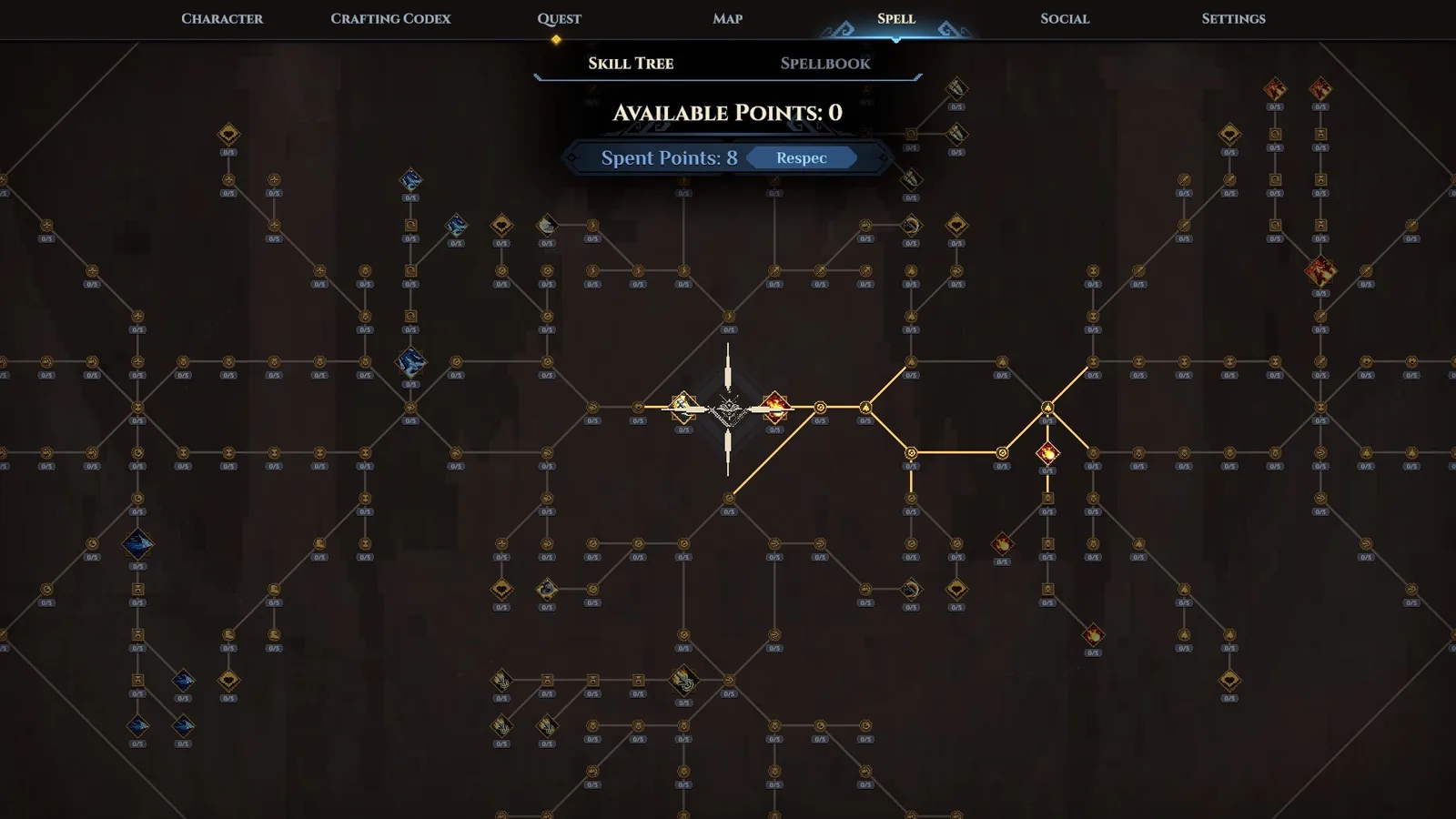
Short answer: every archetype — that is, every race-and-class pairing — gets its own unique skill tree. You open it via SPELL in the top bar, on the SKILL TREE tab. The screen tracks available and spent points and offers a Respec option.
What the interface shows
The most reliable information about the skill tree comes from the game’s own screen. An official store screenshot shows the SPELL panel open with the following readable text.
| On screen | Meaning |
|---|---|
| SPELL (top bar) | The parent menu entry, one of seven top-bar items |
| SKILL TREE | First of two tabs under SPELL |
| SPELLBOOK | Second tab under SPELL |
| AVAILABLE POINTS | Unspent points remaining |
| Spent Points 8 | Points already allocated |
| Respec | A reset option on the screen itself |
Two things follow that are worth stating explicitly. First, the skill tree shares a screen with the spellbook, which means spells and tree allocation are presented as one decision surface. Second, the presence of both “Available Points” and “Spent Points” as separate counters implies a pool model — you accumulate points and distribute them, which is a spend system rather than a milestone-unlock system.
Points are not attribute points. Character attributes are purchased with XP, and Mudtek states the XP cost varies by race–class combination. Skill points appear as a separate counter. The two systems should not be conflated, and Mudtek has not stated whether attribute points can be reset the same way skill points can.
One tree per archetype
The structural rule is stated clearly in Mudtek’s character-creation design post.
Official Design post, 16 November 2025
“The combination of race and class defines your archetype, and every archetype gets its own unique skill tree — built as a blend of race, class, and that archetype's identity.”
“These archetype trees are where you'll find spells and passives that no other archetype can use. They are the anchor of your build: the core set of tools, synergies, and power spikes that you will build around.”
Source: Mudtek Steam announcement, 16 November 2025 · verified 16 September 2026
The phrase “built as a blend” is important. The tree is not a class tree with a racial perk attached; it is composed from three inputs, one of which is the pairing’s own identity. That is why the number of trees scales with the product of races and classes rather than their sum.
| Roster size | Archetypes | Unique trees |
|---|---|---|
| Early Access: 3 races × 3 classes | 9 | 9 |
| 1.0 target: 8 races × 6 classes | 48 | 48 |
Mudtek’s own summary of the intent: “our aim is to provide a huge amount of replayability from the very first screen … With our intended 1.0 roster of 8+ races and 6 classes, that already gives us at least 48 archetypes, each with its own unique tree and passive.”
What the tree contains
Two categories of content live in an archetype tree, and only one of them is exclusive to it.
| Content | Exclusive to the archetype | Also available elsewhere |
|---|---|---|
| Spells from the archetype tree | Yes | — |
| Passives from the archetype tree | Yes | — |
| Racial spells | — | Shared by that race |
| Class spells | — | Shared by that class |
| Spellbook spells | — | Universal, gated by attributes |
So when judging a tree, the question is not “how many spells does it have” but “what can it do that no other pairing can.” Mudtek frames those exclusives as the build’s anchor points: “the core set of tools, synergies, and power spikes that you will build around.”
The archetype passive
Attached to each archetype is a single passive that reinforces one attribute.
Official Design post, 16 November 2025
“This is a simple passive that adds an extra benefit to one of your attributes. For example, the Minotaur Brawler (a Vanguard archetype) gains bonus stamina whenever they level Strength, whereas other archetypes do not. Effectively, each archetype has a ‘primary’ attribute that gives you the most value per point.”
Source: Mudtek Steam announcement, 16 November 2025 · verified 16 September 2026
Note the phrasing: the passive triggers on levelling the attribute, not on a threshold. That means the benefit scales with investment in the primary attribute, which reinforces the same direction as the XP cost structure.
The Early Access overhaul
One detail explains why most existing Dimraeth build advice is suspect.
Official Content update, 2 September 2026
The Early Access feature list includes “skill tree overhaul” among the new content, alongside new elites, new dungeons and difficulty levels.
Source: Mudtek Steam announcement, 2 September 2026 · verified 16 September 2026
A tree overhaul invalidates prior tree-specific planning. Any page describing node layouts, path costs or optimal routes written before September 2026 is describing a build that no longer exists in that form. We deliberately avoid reproducing tree layouts here for exactly this reason, and because Mudtek has not published node-level documentation.
Respec and what it covers
The interface offers Respec on the SKILL TREE screen, so skill point allocation is reversible. Whether attribute points can also be reset has not been published.
That distinction is worth holding onto, because the two systems have very different cost structures. Skill points are a pool you distribute. Attributes are purchased with XP at prices that depend on your race–class combination, and Mudtek states that spending heavily on off-stats leaves you with fewer total points at max level.
Not published Attribute respec
Mudtek has not stated whether attribute allocation can be reversed. Because the interface evidence we have covers the skill tree specifically, we do not extend it to attributes.
Checked against: Steam store page, 30 Mudtek announcements · 16 September 2026
If attribute respec turns out not to exist, that raises the stakes on the attribute plan considerably — which is a good reason to treat the first allocation as provisional until confirmed.
How to approach your tree
Four steps that follow from the documented systems.
1. Identify your exclusive tools first. The tree’s spells and passives are what no other pairing has. Everything else you can acquire elsewhere through race, class or spellbook.
2. Find your primary attribute. The archetype passive points at it. Investing there pays twice — once in the stat, once in the passive.
3. Decide whether you are building a chain. Mudtek’s named interactions — ignite then inferno, frost then freeze, bleed then execute — each require specific tools. If your chosen chain’s pieces are not in your tree, they have to come from a spellbook.
4. Keep a respec in mind, but plan as if you will not need it. Skill points are reversible; attributes may not be. Build the attribute plan conservatively and treat the tree allocation as the flexible part.
Note Points in the shipped build
The screenshot shows Spent Points 8, which is a snapshot of one character rather than a rule about the total pool. Mudtek has not published how many skill points a character earns in total, or whether the pool scales with the level cap of 25.
Source: official Steam store screenshot · captured 16 September 2026